Folk and liturgical Music of Tawang

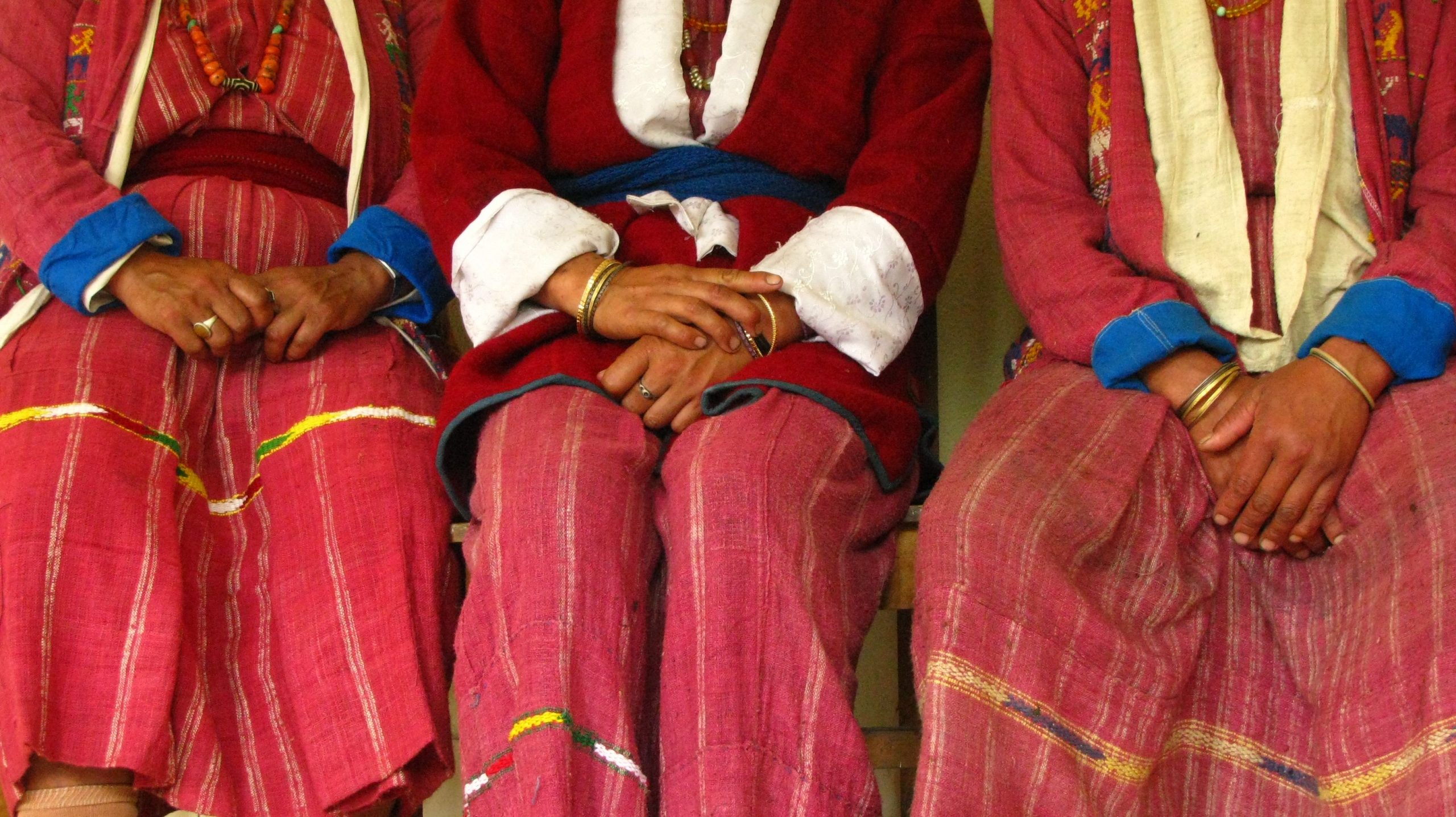
Singers’ hands after a recording session in Zimithang Village. Click on the image to access collection.
| Language | Mönpa, Tibetan |
| Depositor | Tim Motz, Dr. Nikhil Krishnan |
| Affiliation | Oxford University Exploration Club |
| Location | India |
| Collection ID | 0515 |
| Grant ID | |
| Funding Body | Oxford University Expedition Council |
| Collection Status | Collection online |
| Landing Page Handle | http://hdl.handle.net/2196/edc05524-b56c-4d2b-ad9f-e73d38d71306 |
Summary of the collection
The collection contains 68 hours of audio recordings of traditional folk and liturgical music from Tawang District, Arunachal Pradesh, India. Tawang is a Himalayan region, with an average altitude of around 3500m, and borders Tibet to the north and Bhutan on the south and west. The area is almost entirely ethnically Mönpa, a Tibetan Buddhist group with historical links to Tibet.
The recordings were made conducted in 2009 in villages, monasteries and nunneries across Tawang. They are generally supplemented by field notes, transcriptions, and photographs. Most recordings are in Mönpa (for folk music) or Tibetan (for liturgical music).
Group represented
The Mönpa tribe is an ethnic group (population estimated 42,000 at time of research) historically resident in the Greater Tibet region. The Mönpa belong to the Gelugpa and Nyingmapa sects of Tibetan Buddhism, though there are visible signs of the continued influence of some pre-Buddhist Bön traditions. The Mönpa have a long tradition of craftsmanship, particularly in carpet-weaving and wood-carving. There are also traditions of monastic as well as secular folk dances. Tawang Monastery, built during the reign of the fifth Dalai Lama, is an important element of Tawang’s Tibetan heritage, and the second largest Buddhist monastery in the world after the Potala Palace in Tibet. The sixth Dalai Lama, Tsangyang Gyatso (1683-1706) was born in Tawang, an ethnic Mönpa, and is best known for his renunciation of his monastic vows for a lifestyle dedicated to drinking, brothels, and the composition of love poetry that is still part of Tibetan folk culture.
Language information
The Mönpa language belongs to the Tibeto-Burman family, but has been written in the Tibetan script, probably since the 11th century, with some variation depending on region; Tawang Mönpa is one. A large number of Mönpa, mostly men, also speak Tibetan, which is taught in monastery schools and Tibetan schools, such as the one in Kalimpong. Tibetan was often used in liturgical recordings. There are a small number of recordings in Bhutanese and Hindi.
Special characteristics
This is the largest collection of Mönpa folk music of which the team is aware: other collections have tended to focus on Tawang Monastery and the nearby area, without visiting villages around the region.
Collection contents
The corpus contains 68 hours of audio recordings, made at 18 locations in Tawang. Each location has corresponding field notes, containing context and transcription as much was possible for the researchers to gather. Where there are a multiple field notes documents for a single locations, these usually relate to different days’ recording sessions. There are a total of 29 field notes documents, as well of187 accompanying images, of recording artists, the recording sites, and the Tawang countryside.
Audio recordings can broadly be split between folk songs recorded in village settings; and liturgical recordings recorded in monasteries (gonpas) and nunneries (ani gonpas). Folk songs had a range of focusses, such as wedding songs; songs honouring the Yak; flower songs; etc.
Collection history
The research took place over a month in summer 2009. Audio files have been cut and edited into discrete pieces of music/liturgy. The data are also held by the Oxford Research Archive.
Acknowledgement and citation
I wish to acknowledge with profound gratitude the Tawang residents for their generosity and musicality in this work.
I also wish to thank my team members, Leki Norbu, Dr Nikhil Krishnan, Ben Little, and Sarah Skenazy.
The research would not have been possible without the support of the Oxford University Expeditions Council. I am also grateful for our letter of support from the Office of the Tibetan Government-in-Exile, which was an invaluable vote of confidence.
To refer to any data from the collection, please cite as follows:
[Performer name], Motz, Tim, 2009. Folk and liturgical Music of Tawang. Endangered Languages Archive. Handle: http://hdl.handle.net/2196/00-0000-0000-0011-3FCF-C. Accessed on [insert date here].