Linguistic Description and Comprehensive Documentation of Mewahang, an undescribed Tibeto-Burman language of Nepal
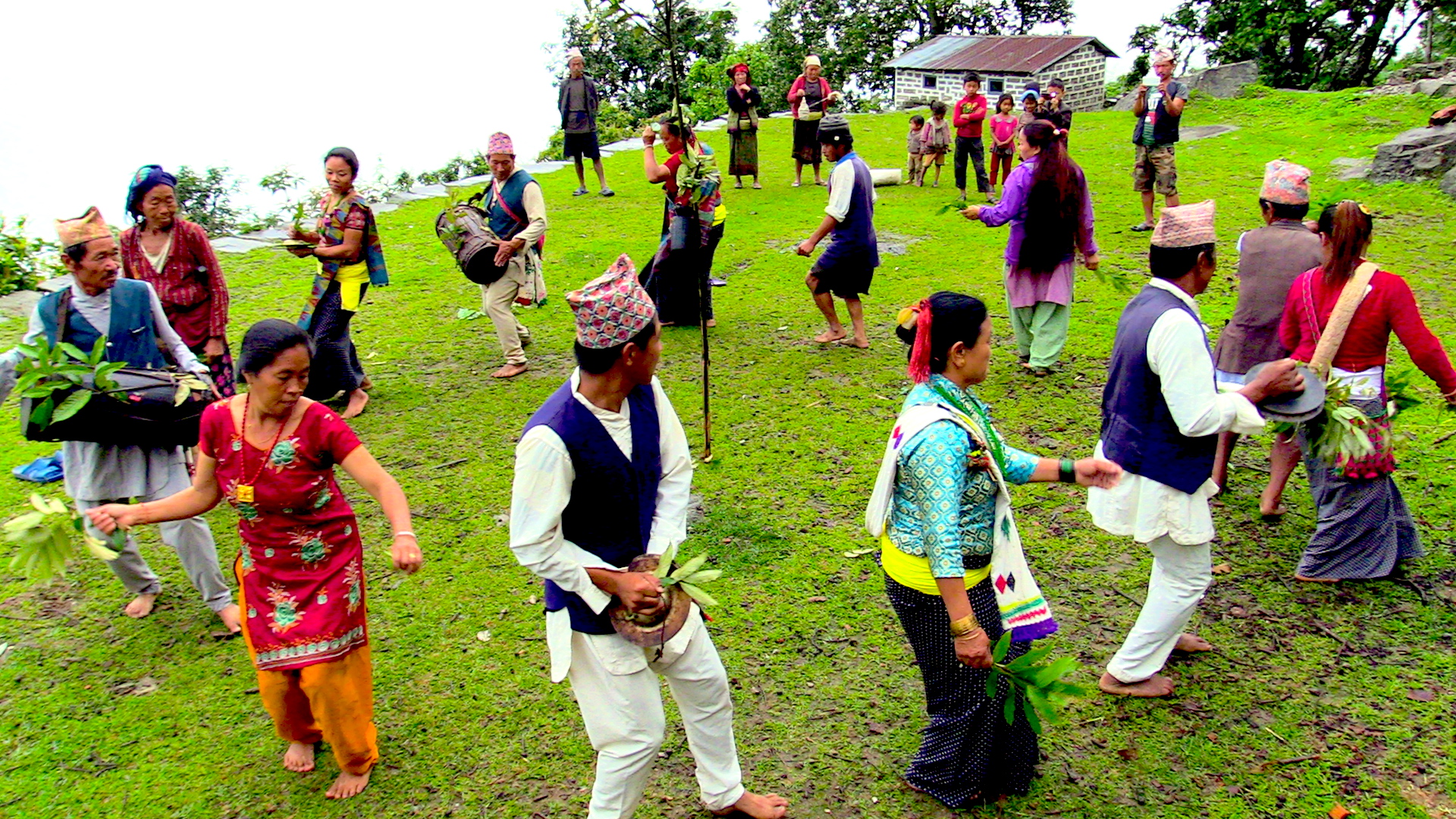
The SILI NACH (Step dance), performed spontaneously by the Mangtewa community in the village of Mangtewa. This cultural dance is popular not noly in Mewahnag community but also in Rai-Kiranti community. Landing page image for the collection “Linguistic Description and Comprehensive Documentation of Mewahang, an undescribed Tibeto-Burman language of Nepal”. Click on image to access collection.
| Language | Eastern Mewahang (ISO639-3:emg), Western Mewahang (ISO639-9:raf) |
| Depositor | Narayan Sharma |
| Affiliation | Department of Linguistics, University of Oregon |
| Location | Nepal |
| Collection ID | 0499 |
| Grant ID | IPF0253 |
| Funding Body | ELDP |
| Collection Status | Collection online |
| Landing Page Handle | http://hdl.handle.net/2196/f5307c2e-7b7a-4858-8044-b15e7f82123c |
Summary of the collection
Mewahang is spoken in the eastern-part of Nepal. Balali (Western) dialect is spoken in the village of Bala, while Yaphule (Eastern) dialect is spoken in the village of Yaphu in Sankhuwasabha district. This collection investigates morphosyntax of both dialects based on a documentation of a culturally significant rich oral tradition rapidly disappearing, unique oral tradition, recipes and shamanistic ritual practices.
The primary data was collected by Narayan Sharma, linguist and principal investigator, along with the assistance of Namita Rai, Jiten Rai, and Anjana Rai (transcribers of the project), and other community member themselves who contributed for the project.
The collection includes an annotated audio-visual documentation corpus with wide range of about 200 speakers belonging in different gender, education, age etc. It also includes a very unique ritual live performance of GHARCHINTA, along with other important rituals like KHAMANAG and SILI NACH, and wedding.
The picture at the top shows SILI NACH (Step dance), performed spontaneously by the Mangtewa community in the village of Mangtewa.
Group represented
The collection created within this project focuses on Mewahang speakers of both Balali Dialect and Yaphule Dialect of Sankhuwasabha district of Nepal. Both dialects are considered standard dialects of both Western and Eastern Mewahang. In the Western Mewahang, the dialect is mainly spoken in Bala village and the retention rate is gradually lowered to Chirkhuwa village (50%) then to Yamdang (5%), while in Eastern Mewahang, the Yaphule dialect is mainly spoken in the village of Yaphu, and the retention is lowered to Mangtewa village (50%) and Tamku village (1%). The Mewahang language spoken in Yamdang and Tamku is almost in the verge of extinction. The language will be lost in Yamdang and Yaphu very soon unless there is any promotional programs that help children to speak that language.
Language information
Mewahang is an oral Tibeto-Burman language of the Kiranti subgroup (Upper-Arun) spoken by approximately 900 people in the Sankhuwasabha district of eastern Nepal.
The Mewahang language has two dialects: Western Mewahang, Balali dialect spoken in the village of Bala and Eastern Mewahang, Yaphule dialect, spoken in the village of Yaphu. The Mewahang people are shifting to Nepali, a lingua franca, while their own language appears to be endangered. With some exception in some households in Yaphu, the children no longer speak the Mewahang language.
The Mewahang spoken areas are surrounded by the neighbouring Kiranti languages: to the west are the Kulung (cf. Tolsma 2006), and their eastern neighbours are the Lohorung (cf. van Driem 2001). The Yamphu are settled to the north of the Mewahang (cf. Rutgers 1998), and to their south are the Sampang (Hanßon 1991).
Mewahang verbs, as Kiranti verbs in general, are characterised by a complex system of agreement where the verbs agree with both Agent (A) and Patient (P) arguments. However, the Mewahang verbal agreement is not always straightforward. Unlike Central Kiranti languages, such as Puma where dative marking is obligatory for animate P arguments and Goal (G) arguments, Mewahang uses consistently an absolutive case for all Patient (P), Theme (T), and Goal (G) arguments. Mewahang appears to be unusual among Kiranti languages in using only a single morpheme for negation, a suffix to express non-past and a prefix to express past tense. Many Kiranti languages possess double or triple negative marking (cf. Sharma 2014).
Special characteristics
This deposit includes data from both Bala and Yaphu village, along with the villages of Chirkhuwa, Yamdang, Mangtewa, Tamku, khandbari and Kathmandu. The dialect spoken in the village of Bala is quite similar in spoken in Chirkhuwa and Yamdanag, while the dialect spoken in Yaphu is quite similar spoken in Mangtewa and Tamku villages.
Collection contents
All bundles in this collection are audio-video recordings. There are about 85 hours of audio-video data, along with about 20 hours of transcribed and translated digital corpus. This total recorded data can further be categorized in the following genres:
- 18 hours of audio-video data about narrative (myth, story, folktale etc.)
- 3.5 hours of conversation and dialogue
- 25 hours of ritual (real marriage, mocking-marriage, gharchinta, khamang, nuwangi, origination etc.)
- 33 hours of description (daily account, life history, family history, autobiography)
- 3.35 hours of singing
- 0.15 hours of poetry
- 1 hour of recipes
There are also:
- 4 hours of recording of real wedding which is entirely in Nepali, not in Mewahang (groom’s ethnic language) or Yakkha (bride’s ethnic language)
- More than 150 comprehensive verb paradigms
- More than 300 hundred elicited sentences covering different Morphosyntactic constructions
Collection history
The data for this collection was collected during the individual postdoctoral research of Narayan Sharma, the Principal Investigator (PI) of the documentation project of the Mewahang language primarily spoken in Sankhuwasabha district at the eastern part of Nepal. The first set of data was collected during April 2018 primarily in Bala, Chirkhuwa and Yamdang of Silichong Rural Municipality-2 which are the core speaking areas of the Bala dialect of the Mewahnag language.
The second set of data was collected during May-June 2018 covering primarily Yaphu speaking areas, the next prominent dialect of Mewahang in Khandbari, Yaphu, Silichong Rural Municipality-5, Mangtewa, Silichong Rural Municipality-4 and Tamku, Silichong Rural Municipality-3 and the third set and fourth set of data was collected during August-September 2018 covering Khandbari and Kathmandu.
When the PI went to fieldwork at the research site, Miss Namita Rai, the research assistant also accompanied except during the second set of recording at the Yaphu site as she was sick and was hospitalized at that time. While recording at the Yaphu site, the research assistant Mr. Jiten Rai was to accompany the PI, along with some dedicated volunteers.
Some important recordings were collected by the research assistants while the PI was at the host institution, the University of Oregon in the USA and they kept transcribing and translating during this period.
Acknowledgement and citation
To refer to any data from the collection, please cite as follows:
Sharma, Narayan P. 2019. Linguistic Description and Comprehensive Documentation of Mewahang, an undescribed Tibeto-Burman language of Nepal. Endangered Languages Archive. Handle: http://hdl.handle.net/2196/00-0000-0000-0010-893A-2. Accessed on [insert date here].