search catalogue
catalogue

Gújjolaay/Jóola Eegimaa (Banjal): An archive of language and cultural material

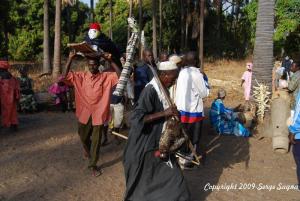
Djiessebenia Bassène (left), Serge Sagna (fieldworker, right) and women from the village of Elubalir (Eloubaline) during a nighttime folktale recording session in 2009. Click on the image to access collection.

Language Gújjolaay Eegimaa
Depositor Serge Sagna
Affiliation The University of Manchester
Location Senegal
Collection ID 0113
Grant ID FTG0021
Funding Body ELDP
Collection Status Collection online
Landing Page Handle http://hdl.handle.net/2196/04d37222-1b75-4b14-81b2-b1ebe1f7e08a

Showreel

Summary of the collection

English: This collection comprises a documentation of some of the most endangered linguistic and cultural materials of Gújjolaay Eegimaa, also known as Jóola Banjal, spoken in Casamance, southern Senegal. It primarily consists of spontaneous, naturalistic recordings of adult speech in both audio and video formats. These recordings encompass a variety of speech genres, including narratives, interviews, and funeral dirges. All data were collected in the Eegimaa language. The deposit showcases a wide range of language practices and cultural and religious topics, such as ritual speech, the kinship system and social organisation. It also contains records of ethnobiological knowledge and rice farming techniques among Jóola people. This rich body of material is intended to support and inspire language revitalisation and research across multiple disciplines, including linguistics, anthropology, ethnomusicology, and ethnobiology.

Résumé de la collection

Français: Cette archive documente certains des phénomènes linguistiques et culturels les plus menacés du gújjolaay eegimaa, une langue parlée en Casamance, au sud du Sénégal, également connue sous le nom de jóola banjal. Elle contient principalement des enregistrements audio et vidéo de discours spontanés et naturels, couvrant divers genres tels que des récits, des entretiens et des chants funèbres. Toutes les données ont été recueillies en langue eegimaa. L’archive met en lumière une grande diversité de pratiques linguistiques ainsi que des phénomènes culturels et religieux, notamment les discours rituels, le système de parenté et l’organisation sociale. Elle comprend également des informations précieuses sur les savoirs ethno-biologiques et les techniques de riziculture en pays Jóola. Nous espérons que la richesse et la diversité de cette archive contribueront à la revitalisation de la langue et serviront de ressource pour des recherches en linguistique, anthropologie, ethnomusicologie et ethnobiologie etc.


Group represented

English: The Eegimaa people are a subgroup of the Jóola ethnic group, found across The Gambia, southern Senegal, and northern Guinea-Bissau. Within the broader Jóola group, the Eegimaa are a minority, residing in a former kingdom of ten villages known as Mof-Ávvi (“The king’s land”). The Eegimaa king serves primarily as a religious figure and rainmaker, rather than a political leader. The villages documented include Bajjat (Badiatte), Essil (Essyl), Batiŋer (Batighere), Gáabal (Kamobeul), Enappor (Enampor), Sállagi (Séléki), Elubalir (Elubaline), Batiŋer Bulan (Batighere Bolon), Ettama (Etama), and Banjal (Bandial). The French-based official orthographical representation of these village names is put between brackets. Eegimaa is spoken by an estimated 10,000 to 13,000 people. Traditionally, the community relies mainly on rice farming cattle breeding and fishing, with palm tree exploitation also playing a significant role in their economy. Daily and seasonal life is deeply rooted in their traditional monotheistic religion, although Christianity and, to a lesser extent, Islam are also widely practiced.

Le groupe présenté

Français: Les locuteurs du eegimaa forment un sous-groupe de l’ethnie jóola, présente en Gambie, au sud du Sénégal et au nord de la Guinée-Bissau. Au sein de ce groupe, les locuteurs du eegimaa constituent une minorité vivant dans un ancien royaume composé de dix villages, appelé Mof-Ávvi, ce qui signifie « la terre du roi ». Chez les Jóolas Eegimaa, le roi est avant tout une figure religieuse et un prêtre de la pluie, plutôt qu’un dirigeant politique. Les villages représentés dans cette archive sont : Bajjat (Badiatte), Essil (Essyl), Batiŋer (Batighere), Gáabal (Kamobeul), Enappor (Enampor), Sállagi (Seleki), Elubalir (Elubaline), Batiŋer Bulan (Batighere Bolon), Ettama (Etama) et Banjal (Bandial). L’orthographe officielle des noms de villages, basée sur le français, est indiquée entre parenthèses. Selon les estimations, la langue eegimaa est parlée par une population comprise entre 10 000 et 13 000 locuteurs. Les Jóolas Eegimaa vivent principalement de la riziculture, de l’élevage et de la pêche. L’exploitation des palmiers à huile constitue également une activité centrale de l’économie locale. La vie quotidienne et les activités saisonnières sont largement structurées par la religion traditionnelle monothéiste, bien que le christianisme — et dans une moindre mesure l’islam — soient aujourd’hui très présents dans les villages.


Language information

English: Eegimaa (also known as Banjal) is part of the Jóola cluster of languages and dialects, which belong to the Atlantic branch of the Niger-Congo language phylum. Its key grammatical features include vowel harmony based on ATR and backness, a noun class system, an overt verb classification system, a nominal tense-aspect-mood (TAM) system, and a complex semantic agreement system with lexical hybrids. Mutually intelligible dialects of Eegimaa are spoken in Affiniam, Boutoeum, and Djilapaor, located on the northern bank of the Casamance River. The Eegimaa-speaking area is monoethnic and predominantly monolingual, with Eegimaa serving as the default language of communication across all villages. However, due to schooling in French and significant migration to urban areas in last five decades, many current speakers are multilingual—especially in Wolof and French. Language mixing is common among younger and literate speakers, but less so among older generations in the recordings.

Informations sur la langue

Français: Le eegimaa (ou Banjal) fait partie du groupe de langues et dialectes jóola, rattaché à la branche atlantique du phylum Niger-Congo. Ses principales caractéristiques grammaticales incluent l’harmonie vocalique fondée sur les traits ATR et la postériorité, un système de classes nominales, un système de classification verbale ouvert, un système nominal de temps-aspect-mode (TAM), ainsi qu’un système complexe d’accord sémantique impliquant des noms hybrides. Des variétés mutuellement intelligibles sont parlées dans les villages d’Affiniam, Boutoeum et Djilapaor, au nord du fleuve Casamance. Les locuteurs vivent dans une région mono-ethnique et majoritairement monolingue, où le eegimaa est la langue de communication par défaut. Cependant, la scolarisation en français et l’exode rural des cinquante dernières années ont favorisé le multilinguisme, notamment en wolof et en français. Les alternances de langues sont fréquentes chez les migrants et les locuteurs scolarisés, mais plus rares chez les plus vieux participants dans nos enregistrements.


Special characteristics

English: What makes this repository unique is its focus on ethnographic data collection from an insider’s perspective, conducted by a member of the Eegimaa-speaking community. Topics were either chosen by the fieldworker or suggested by other speakers. As a native speaker, the fieldworker was able to conduct monolingual interviews with language consultants. The repository also includes a rich body of data featuring language mixing, particularly from younger and literate speakers, offering valuable material for analysing language contact. A deliberate effort was made to capture language in its most natural form—through spontaneous communicative events rather than elicited responses. This approach reflects the belief that linguistic structures, such as nominal classification systems, mirror speakers’ conceptualizations of the world and are best understood through culturally informed linguistic analysis.

Particularité de l’archive

Français: Ce qui rend cette archive unique, c’est son accent sur la collecte de données ethnographiques depuis une perspective interne, menée par un membre de la communauté locutrice du eegimaa. Les thèmes ont été choisis soit par l’enquêteur de terrain, soit suggérés par d’autres locuteurs. En tant que locuteur natif, l’enquêteur a pu réaliser des entretiens monolingues avec les informateurs. L’archive comprend également un riche corpus de données contenant des interactions linguistiques, notamment chez les jeunes locuteurs et ceux scolarisés, offrant ainsi un matériau précieux pour l’analyse du contact des langues.
Un effort délibéré a été fait pour capturer la langue dans sa forme la plus naturelle — à travers des événements communicatifs spontanés plutôt que des réponses élicitées. Cette approche reflète la conviction que les structures linguistiques, telles que les systèmes de classification nominale, reflètent les conceptualisations du monde des locuteurs et sont mieux comprises à travers une analyse linguistique ancrée dans la culture.


Collection contents

English: The documentation of Eegimaa is an ongoing project that aims to capture speakers’ individual and collective knowledge of their environment and how their world view is encode in the language. The current archive includes over 100 photos, 91 audio files, and 12 videos featuring conversations, narratives, village meetings, traditional trials, rituals, and procedurals that demonstrate practices like palm wine extraction, myrrh production, and fabric weaving. Most materials are observed communicative events and monolingual interviews explaining the meaning and context of cultural and linguistic practices. The photos depict community members, artifacts, and cultural events. Some recordings are restricted due to culturally sensitive content. Additional materials collected after the ELDP-funded phase will be added soon to expand the collection.

Contenu de la collection

Français: La documentation du eegimaa est un projet en cours visant à capturer les connaissances individuelles et collectives des locuteurs sur leur environnement, ainsi que la manière dont leur vision du monde est encodée dans la langue. L’archive actuelle comprend plus de 100 photos, 91 enregistrements audio et 12 vidéos présentant des conversations, récits, réunions de village, procès traditionnels, rituels et démonstrations de pratiques telles que l’extraction de vin de palme, la production de myrrhe et le tissage de tissus.
La majorité des enregistrements sont des événements communicatifs observés et des entretiens monolingues expliquant le sens et le contexte des pratiques culturelles et linguistiques. Les photos montrent des membres de la communauté, des objets culturels et des événements traditionnels.
Certains enregistrements sont restreints en raison de leur contenu culturellement sensible. Des matériaux supplémentaires, collectés après la phase financée par l’ELDP, seront bientôt ajoutés pour enrichir la collection.


Collection history

English: The documentation of Eegimaa was supported by ELDP funding, initially for the depositor’s Ph.D. research on the language’s nominal classification system (FTG0021, 2005–2006), and later for a postdoctoral project (IPF0141, 2008–2010).
Additional recordings from both earlier and more recent projects will soon be added to this collection.

Histoire de la collection

Français: La documentation du eegimaa a été financée par ELDP, d’abord dans le cadre de la recherche doctorale de l’enquêteur sur le système de classification nominale de la langue (FTG0021, 2005–2006), puis dans le cadre d’un projet de recherche postdoctoral (IPF0141, 2008–2010). Des enregistrements collectés lors de projets antérieurs et plus récents seront également ajoutés prochainement à cette collection.


Other information

English: Most recordings have been transcribed and primarily translated into French, with some also available in English. The transcription follows the orthographic conventions established by Sagna (2011). Eegimaa native speakers were trained to transcribe the recordings using this system. However, since many of them were primarily literate in French, the orthographic conventions were not always consistently applied. Some of the French transcriptions will also be revised for accuracy and consistency.

Autres informations

Français: La plupart des enregistrements ont été transcrits et principalement traduits en français, certains également en anglais. La transcription suit les conventions orthographiques établies par Sagna (2011). Des locuteurs natifs du Eegimaa ont été formés à la transcription selon cette orthographe. Toutefois, comme beaucoup étaient principalement alphabétisés en français, les conventions n’ont pas toujours été rigoureusement respectées. Certaines traductions en français seront également révisées pour en améliorer la qualité et la cohérence.


References

Bassène, Alain-Christian. 2012. Concurrence entre critères morphologiques et critères sémantiques dans les accords de classe: le cas du jóola banjal. African Linguistica 18. 261–277.

Bassène, Alain-Christian. 2007. Morphosyntaxe du jóola banjal. Köln: Rüdiger Köppe Verlag.

Bassene, Mamadou. 2012. Morphophonology of Joola Eegimaa. PhD Dissertation. The Faculty of the Graduate School, University of Minnesota.

Sagna, Serge. 2008. Formal and semantic properties of the Gújjolaay Eegimaa (A.k.a Banjal) nominal classification system. PhD Dissertation. Department of Linguistics, SOAS, University of London.

Sagna, Serge. 2011a. L’alphabet du Gújjolaay Eegimaa. http://www.humanities.manchester.ac.uk/medialibrary/llc/files/sagna/R%E9sum%E9-Alphabet-Eegimaa-Serge.pdf (15 Nov. 2016). (25 August, 2015).

Sagna, Serge. 2011b. Semantic categorisations in the Gújjolaay Eegimaa collectives and distributives. In Peter K. Austin, Oliver Richards-Bond, David Nathan & Lutz Marten (eds.), Proceedings of Conference on Language Documentation and Linguistic Theory 3, 1–10. London: Department of Linguistics, SOAS. (17 September, 2014).

Sagna, Serge. 2012. Physical properties and culture-specific factors as principles of semantic categorisation of the Gújjolaay Eegimaa noun class system. Cognitive Linguistics 23(1). 129–163. https://doi.org/10.1515/cog-2012-0005.

Sagna, Serge. 2014. Taxonomic hierarchies in the Gújjolaay Eegimaa ethnobotany: How useful are Berlin’s universal criteria? In Aicha Belkadi, Kakia Chatsiou & Kirsty Rowan (eds.), Proceedings of Conference on Language Documentation and Linguistic Theory 4. London: SOAS.

Sagna, Serge. 2016. ‘Research impact’ and how it can help endangered languages. Foundation for Endangered Languages, OGMIOS 59. 5–8.

Sagna, Serge. 2022. Cross-categorial classification: Nouns and verbs in Eegimaa (Empirical Approaches to Language Typology [EALT]). Vol. 60. Berlin: De Gruyter Mouton.

Sagna, Serge & Emmanuel Bassène. 2016. Why are they named after death? Name giving, name changing and death prevention names in Gújjolaay Eegimaa (Banjal). In Mandana Seyfeddinipur (ed.), African language documentation: New data, methods and approaches, Special Publication No.10 of Language Documentation & Conservation, 40–70. http://hdl.handle.net/10125/24652.

Sagna, Serge & Abbie Hantgan. 2021. African multilingualism viewed from another angle: Challenging the Casamance exception. International Journal of Bilingualism. SAGE Publications Ltd 25(4). 939–958. https://doi.org/10.1177/13670069211023146.

Tendeng, Odile. 2007. Le Gusiilay: un essai de systématisation. Une contribution à l’étude di Jóola. Berlin: Peter Lang.


Acknowledgement and citation

To refer to any data from the collection, please cite as follows:

Sagna, Serge. 2011. Gújjolaay/Jóola Eegimaa (Banjal): An archive of language and cultural material. Endangered Languages Archive.  Handle: http://hdl.handle.net/2196/00-0000-0000-0001-EF8A-5. Accessed on [insert date here].

Powered by Preservica
© Copyright 2025