Palawan-Tagalog-English Dictionary
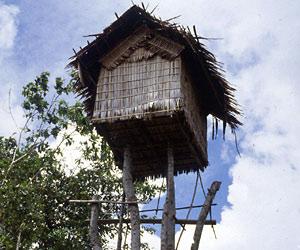
Landing page image for the collection “Palawan-Tagalog-English Dictionary”. Click on image to access collection.
| Language | Palawan |
| Depositor | Charles Macdonald |
| Affiliation | Centre National de la Recherche Scientifique |
| Location | Philippines |
| Collection ID | 0008 |
| Grant ID | FTG0114, FTG0144 |
| Funding Body | ELDP |
| Collection Status | Collection online |
| Landing Page Handle | http://hdl.handle.net/2196/cf5751d1-d05f-4d34-acfe-a07cf48f59c2 |
Summary of the collection
This deposit consists of the first ever dictionary of Palawan, spoken in Palawan Province, Philippines, resulting from fieldwork conducted between July 2008 and March 2009. The dictionary is currently available in PDF, RTF and Toolbox database formats.
The image shows a Palawan pupuq, a “small small bachelor’s or maiden’s house”, serving as a meeting place for unmarried boys and girls. For more information search the dictionary, or search for ‘pupuq’ in the deposit resources to find the full-sized image.
Group represented
Palawan
Special characteristics
This is the first ever extensive compilation in dictionary form of the Palawan language.
Collection contents
The collection comprises over 3400 entries in a Palawan lexicon with Tagalog and English glosses.
Entries include:
- speech part,
- dialectal variants,
- Tagalog gloss(es),
- English gloss(es),
- affixed forms,
- example (a sentence),
- translation of example in English and Tagalog,
- synonyms, and
- ethnographic description.
Collection history
Materials include a previous database of 1200 entries that have been collected through the years from various sources.
They are mostly recordings that have been transcribed and translated with the help of informants: during the period covered by the ELDP project (2006-7) handwritten lists were compiled by native speakers and then checked/rewritten by the depositor with the help of informants/native speakers.
Other lists to be included in the dictionary are glossaries and lexicons from various published sources (the depositor’s, Revel’s, SIL primers, etc.).
Other information
Thanks to Ian and Sue McQuay from SIL Philippines the Palawan dictionary is now online in interactive form at http://www.sil.org/asia/Philippines/works-pal.html.
This is a work in progress, and the author would be extremely grateful for your comments and suggestions in order to improve it, add lexemes (a number of important lexemes are still missing) make corrections, especially to the Tagalog.
To send your comments and suggestions, and to input new entries (words or records), please visit http://palawandictionary.wordpress.com/. Kindly post your messages at this address. In due time your contributions will be inserted in the online version of the dictionary which cannot be changed, but only accessed for consultation and copy.
Acknowledgement and citation
Users are requested to acknowledge the depositor, Charles Macdonald, when citing resources from this collection.
To refer to any data from the collection, please cite as follows:
Macdonald, Charles. 2008. Palawan-Tagalog-English Dictionary. Endangered Languages Archive. Handle: http://hdl.handle.net/2196/00-0000-0000-0000-F414-7. Accessed on [insert date here].